"And now, go, write it before them on a tablet, and inscribe it in a book, that it may be for the time to come as a witness forever.” Isaiah 30:8
The First Presbyterian Church of El Dorado was organized in March of 1846 by the Rev. W. S. Lacy. A church building was erected on a lot just west of and directly across the street from the old Presbyterian Cemetery, which is on a street now known as South Washington. Mr. Lacy preached the first sermon. The Rev. A. R. Banks also assisted in the organization of the church and Robert Hardy and William F. Lawson were made Elders. After one year, Mr. Lacy resigned to continue his mission work and Mr. Banks filled the pulpit for the next four years. Following Mr. Banks, there was a long time in which the church had no regular pastor.
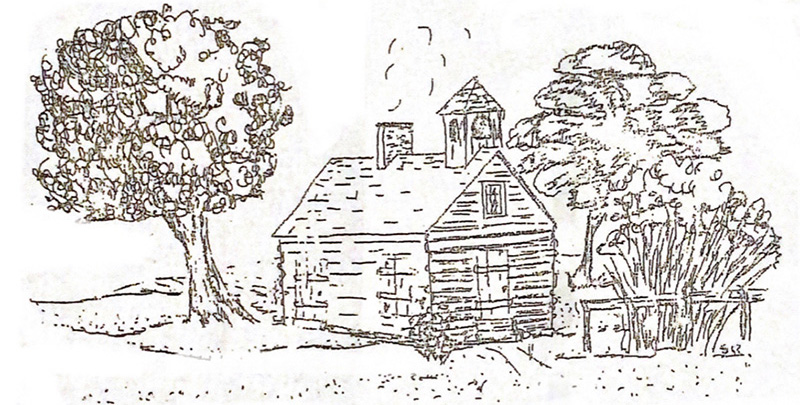
On the 1848 plat of El Dorado is a place designated "Graveyard" and across from it is a small house marked "PC" for "Presbyterian Church." Matthew F. Rainey was one of the Associate Justices of the county court who signed the order approving this plat. No records or pictures are available as to the size and design of this first church except that a "Small building" was constructed. Sometime during the early 1860's a severe storm wrecked the little church.
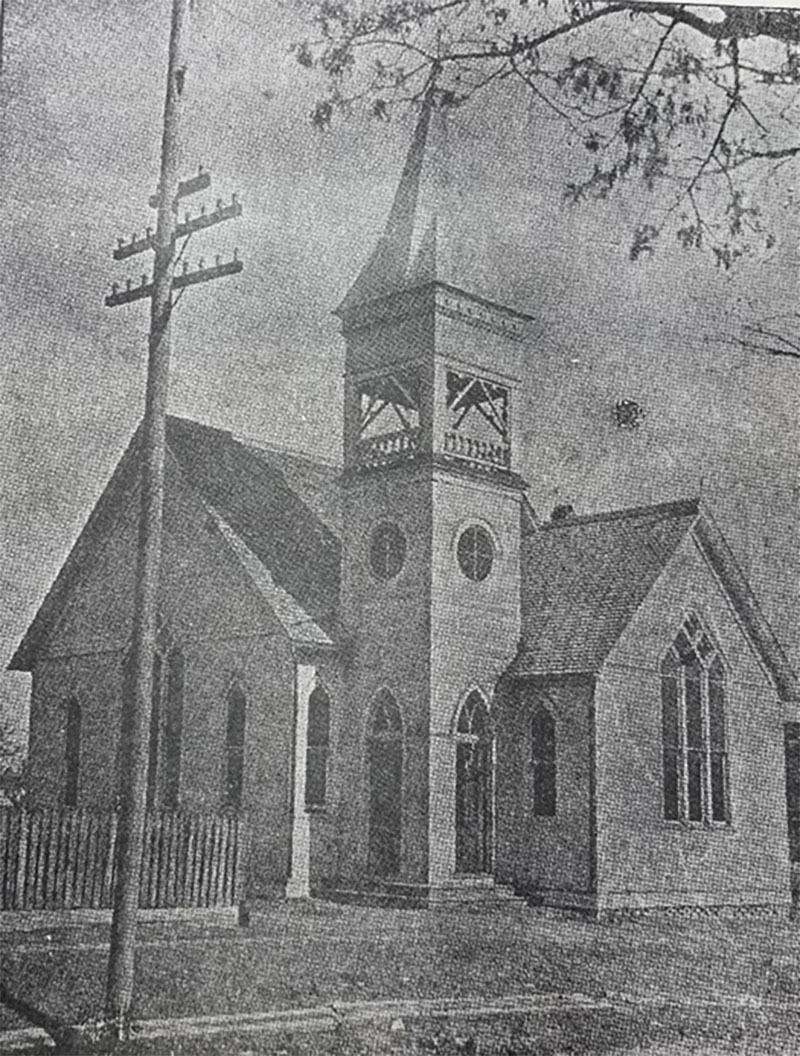
After the church was reorganized in 1868, a new church was built at the northwest corner of Hill and East Main Streets. It was a small frame structure built on property purchased by Peter G. Craig and donated to the church. Money from the sale of the original South Washington Street church property was used to purchase lumber and other materials for the new church. After two years of hard struggle, the building was completed and furnished with neat home-made furniture. It cost about $2,600, was debt free, and dedicated on June 29th, 1872.
In 1896 it was voted by the congregation to erect a new church building. The Hill and Main Streets site had become undesirable because a hotel was built almost up to the church on the west side. Since the lot for the church had been given by Peter G, Craig, Mrs. Craig, his widow, exchanged the lot for one of like dimensions on the southeast corner of the next block east. The new church was completed in 1897 and the new furniture installed. 'The building was dedicated, debt free, in the fall of 1898. Several of our current members remember this church with fond memories. It was a small but dedicated congregation. The bell's sweet tones could be heard in a three mile radius of the church. This bell was lost when the church was dismantled and all efforts to locate it have been fruitless. The building was heated with a coal stove and water was carried for church pot luck dinners from the Craig home next door. Surreys, buggies, and saddle horses were a quite common sight at a Sunday service. Automobiles were not common at this church until the Oil Boom days of the early twenties.
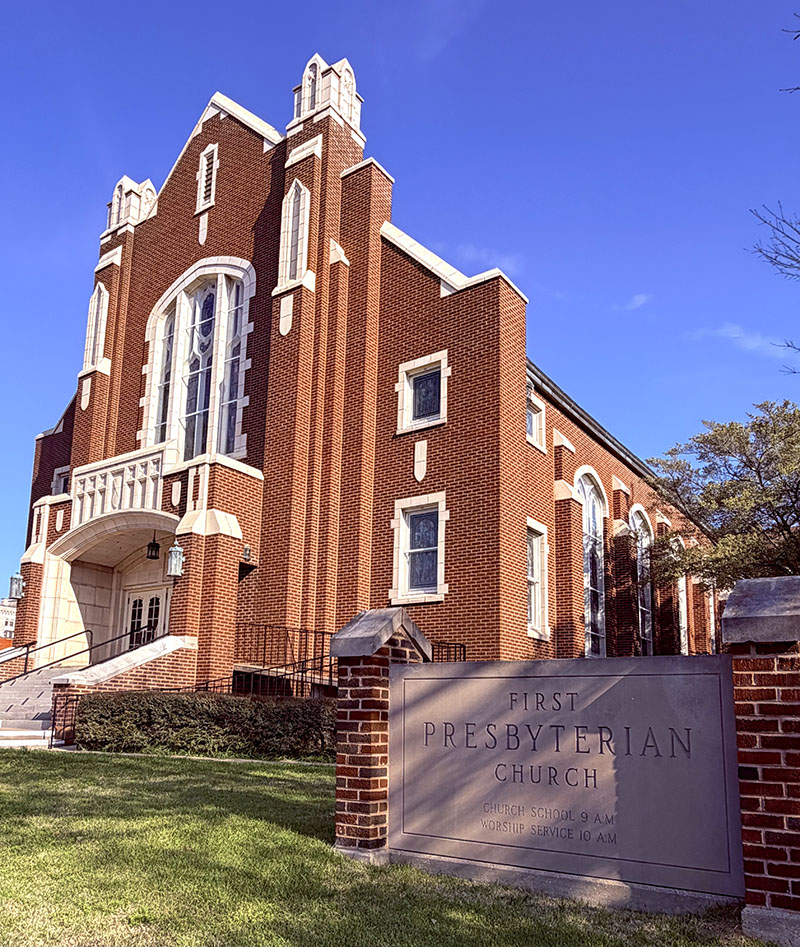
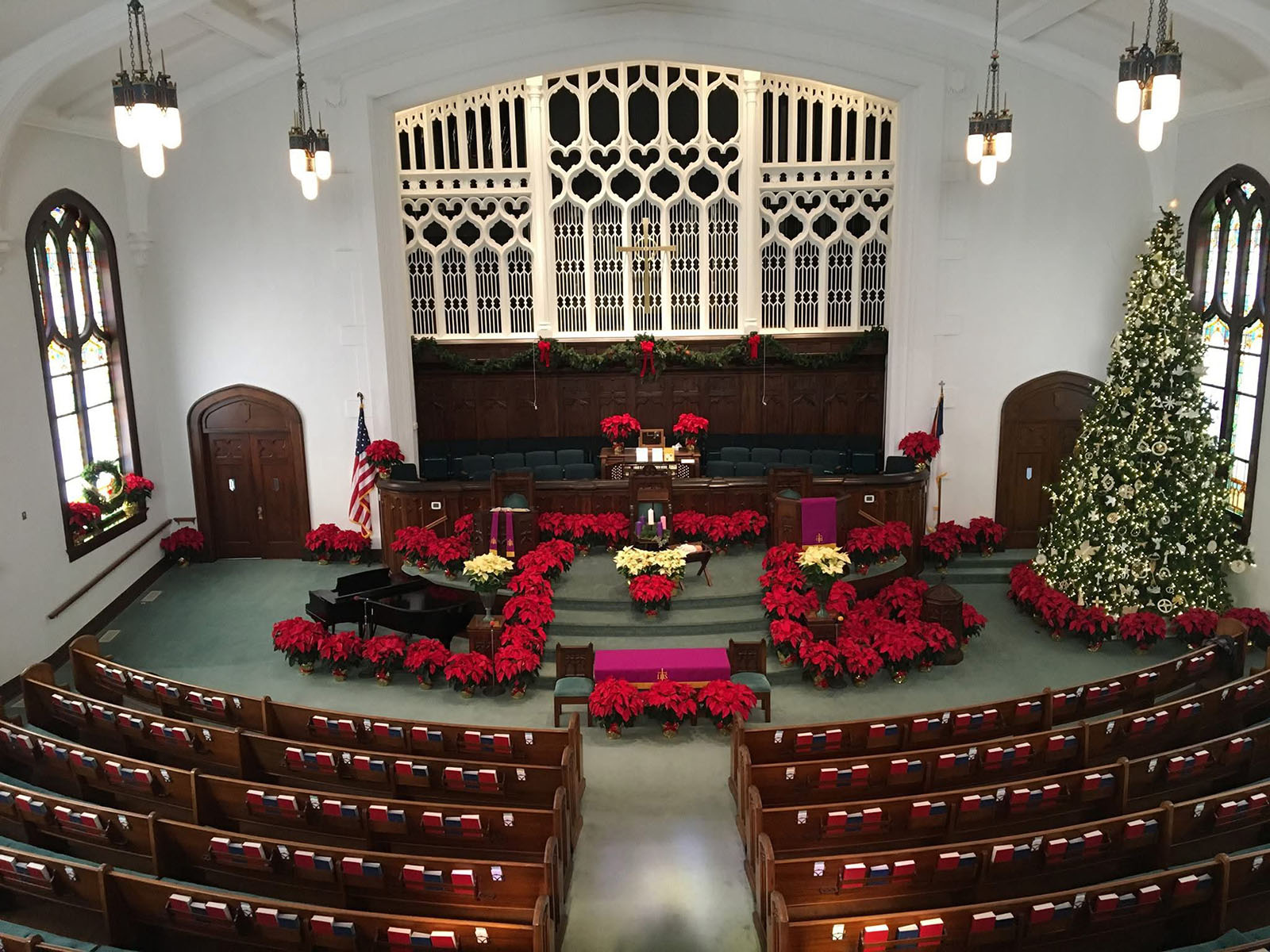
The building was designed by the firm of R. H. Hunt and Associates in the Collegiate Gothic Style. The church was constructed out of red brick and white terra cotta, with a roof of green tiles and was completed in October 1926. This building was built to accommodate the growing congregation during the oil boom era. James A. Rowland gave the money to purchase the sanctuary windows. The women’s Auxiliary raised the money to purchase the Moller four manual pipe organ that is still in use today. The organ was rebuilt in 1975 and refurbished again in 2000 due to storm damage to the pipes. Our organ recently underwent another refurbishment in 2025.
First Presbyterian Church was added to the National Register of Historic Places in 1991.